Showing posts with label Guirim Free Legal Aid Cell. Show all posts

Saturday, 11 February 2017

Guirim Free Legal Aid Cell – Program on Child Rights


The program was organized by the Gurim Free Legal Aid Cell in collaboration with Childline, on the 11th of February, 2017 in order to spread awareness about the rights of children. The program was held at Guirim Panchayat Hall.  The faculty in charge of the Cell, Prof. Pearl Monteiro was present for the same.


It was an hour long session and commenced at 3:30 pm. The members had conducted campaigning in the neighbourhood day in advance, which ensured an audience of about people, of which 22 were children from the neighboring schools.

Wednesday, 16 December 2015

Guirim Free Legal Aid Cell hits a Hatrick ! This time Legal Awareness on Disability/ AIDS Rrelated Laws

DATE: 16/12/2015
VENUE: Village Panchayat Hall, Guirim
TOPIC FOR MAJOR PROGRAMME: Disability/AIDS related laws by Dr. Rui Da Gama and Protection of Women from Domestic Violence Act, 2005 by Adv. Suraksha Gawas.
TEACHER INCHARGE: Mrs. Pearl Monteiro- Asst. Professor, VMSCL.
MEMBERS PRESENT: Afrah Shaikh, Shantanu Karnik, Dorika Dias, Sr. Jolly George, Siya Parob.


On this day, 16/12/2015, North Goa Legal Services Authority, Panaji (Mapusa cell) in collaboration with Guirim Free Legal Aid Cell, VMSCL organized a legal awareness programme for the Villagers of Guirim. The topics approved by the Chairman of the North Goa Legal Services Authority, Panaji for the legal awareness programme were - Disability/AIDS related laws and Protection of Women from Domestic Violence Act, 2005.


The legal awareness programme was organized for 30 persons and rigorous campaigning was done by the student cell members, present for the programme. The speakers were arranged by the North Goa Legal Services Authority, Panaji (Mapusa cell). All costs for the programme were also borne by the North Goa Legal Services Authority, Panaji (Mapusa cell) and no costs were incurred by Legal Aid Cell. Since two Major Programmes were successfully completed by the cell for the academic year, the teacher Incharge- Mrs. Pearl Monteiro entrusted Afrah Shaikh (Cell Incharge) to go forward with the programme.

Around 25 villagers were present at 4:00 pm. Mrs. Gauri Dessai being the representative of the North Goa Legal Services Authority, Mapusa Cell, compared the programme and briefly introduced the Legal Services Authority and told its functions whereas Afrah Shaikh gave an introduction to Guirim Free Legal Aid Cell, VMSCL and explained its functions. Then the talk commenced. The entire programme was conducted in Konkani. There were two speakers namely Dr. Rui Da Gama and Adv. Suraksha Gawas.


Dr. Rui Da Gama spoke about disability/Aids. He said:
  • There are various disabilities, some are disabled by birth, while some due to an accident, some have polio etc. but for the facility of such people it is made necessary for all public institutions to have a ramp where a wheel chair can go till the last floor and a railing where the visually impaired can take help of it.
  • Also there are mentally challenged and government tries to reach out to them too. But most people call them mad and make fun of them which is wrong.
  • The important point here is that these disabilities can be seen whereas there are many other kinds of disabilities which are invisible.
  • Among such disabilities, one such disability is HIV/AIDS.
  • Nobody really knows how HIV virus came into existence, however there are various theories. Some say it’s a curse to mankind for having illicit sexual relation outside marriage. Whereas some say it is due to a sexual relation of a human with a monkey.
  • How it came into existence is not really important but in today’s world awareness about the HIV virus and AIDS is how we can save ourselves and others from the virus since it is a contagious one. Contagious means it spreads.
  • When the virus first attacks a person, in its initial stage it is known as HIV virus, but later is known as AIDS for which no cure has been found till date. HIV/ AIDS makes a person weak and the person is more prone to all kinds of sicknesses due to a weak immune system.
  • The best and the first way to avoid HIV by persons who are not infected is to be committed in the relation and not to have illicit relationships. In an illicit relation you do not know the status of another person whether the person is infected or not and therefore, you are at a huge risk, where you not only endanger yourself but also your married partner.
  • One of the ways is by intimate kiss with an HIV positive person. The moral being that HIV spread can be reduced by following simple laws of marriage.
  • Another way is from HIV positive mother to her expected child in her womb. But these days a child of an HIV positive mother can be saved from being infected with the help of medicines before birth. However, for this awareness is important.
  • There are several children in Asha Bhawan. They have AIDS and do not have a long life and most of them are HIV positive by birth. This could be avoided if their mothers were medicated when expecting.
  • If a person has a cut and if it comes in contact with the virus then the person can get infected therefore, people should take utmost care while using public toilets.
  • HIV can also spread through multiple use of the same syringe. Some unethical doctors use the same syringe for several patients. This can also be a mode of spreading the virus because if the syringe comes in contact with an infected person through the blood, then it shall not be seen but stay there and attack all the others on whom the same syringe is used. Therefore, it is a law that disposable syringes be used and disposed after one use. Care should also be taken for blood donation. Each person donating blood should be tested for any kind of diseases including AIDS.
  •  Young girls and boys sometimes get carried away in a relationship but in our country, India there still exists a concept of marriage. If the young generation does not wait for marriage to fulfill their sexual needs then there is a high risk of HIV/AIDS.
  • Currently in Mumbai, 5 lakh HIV positive patients are detected.
  • It is a suggestion that every person while getting married should get examined for HIV as a safety measure.
  • One should not get disabled by getting infected by this virus. AIDS makes a person weak and disabled. One must take precautions and avoid the social stigma associated with it. GMC provides with medicines and treatment for the infected.
  • Dr. Rui Da Gama lastly said that all people present must pass this information to other people because only information, knowledge and precaution can help avoid the deadly virus.
Then Adv. Suraksha Gawas spoke on Protection of Women from Domestic Violence Act, 2005. She said:
  • The Act is implemented to protect women from all kinds of domestic violence. Violence means any kind of ill treatment whether mental or physical and domestic means within a house, violence done by husband or son or any other family member on a women.
  • This act is specially implemented to protect women because when she gets married, her world changes completely, she goes to a new house and has to adjust herself as per the new house, which in itself is a challenge.
  • Sometimes the in-laws are nice but due to various reasons such as culture differences, or simply because it is another family, it is difficult for the girl to be happily married ever after.
  • The reasons can be several or just one. The husband and the in- laws may trouble because may be dowry was not given, or the husband may ignore the wife as he has another women in life.
  • Women adjust to all this and if not maintained by the husband , have to maintain themselves, look after her children, their school fees etc. all by herself and manage everything.
  • For this reason, the Act is implemented to help, protect and safeguard the interest of women and in Goa many women have got relief under the Act.
  • We get several cases of domestic violence now because gone are the days when women kept quiet and accepted everything.
  • A case under Domestic violence can be filed if any kind of violence exists. Violence includes bad words, hitting, slapping, keeping names, insulting, drinking and behaving badly or any other kind of emotional, mental, monetary and/or physical abuse.
  • Some women go through the torture but do not file a complaint because taking the family to the police etc. will be a shameful to her in- laws and her family and to herself. They also think that they do not have any knowledge of the law any how will they go about, and at the end of the day they have to live with my family, then how to go against them, monetary factor etc. are some of the worries.
  • The Act does not say that if there is a simple argument, a woman should go and file a case. There are many cases filed to torture the husband and in-laws but there are many women going through real torture and suffering which end up in suicides or murders, and to avoid this and the help the women who are in need of such help this act is a blessing for them.
  • There are two ways by which common people can seek help.
  • One is by writing a report of the problems to the BDO Protection Officer. And he will take care of all the other matter, investigate and take the matter to court.
  • Second is by directly making an application to the Magistrate.
  • As per the problem, various reliefs can be asked for: if husband, mother-in- law, daughter-in –law all stay in the same house and the mother-in-law or any other person removes her from the house and no other house is there to stay then can ask for residence order. I.e. a share in the house to stay and if not in the house then somewhere else a room to stay.
  • Protection order in fear of husband or any other member beating or insulting.
  • Monetary relief when no money being given to the wife. She can also attach the husbands salary if he is a government servant.
  • Custodian order can be asked for the benefit of the children.
  • Medical facility is also provided to the aggrieved.
  • Maintenance order for children and for self can be asked for. In a divorce petition only compensation can be asked for but under domestic violence Act, maintenance can be asked and also compensation can be asked Which is not limited to amount.
  • Maintainence for children can be asked being their natural guardian.
  • Old ladies in the house are sometimes troubled and not looked after, they too can ask for maintenance under this act.
  • Certified copy of the act is avail free of cost for Women.
  • No money may be spent by a woman for filing a case since they can avail free legal aid services, which is free of cost for women. They only have to apply to the government telling about the case to be filed and ask for an Advocate.


Various questions with regard to what can be done if the woman does not want to take her family to the police station and the court but wants relief because if matters go to court, relations worsen, and what can be done in such situations and some other related questions were asked. The speaker answered all the queries one by one and cleared the doubts. She said that in panjim there is a commission set up for women, where any person, an aggrieved or any one on behalf of the aggreived can write to them where in matters are solved without taking family to the police station. But the aggrieved has to be present. Lastly she said that if anyone is aware of any person suffering and needs protection, it is each ones responsibility to inform them to reduce their suffering and protect women from violence.

All the people were happy and very impressed with the talk of both speakers. Also meanwhile, the refreshments were served. The programme ended with some group pictures.

Friday, 4 December 2015

Awareness on Safe Use of Internet - A Guirim Free Legal Aid Cell Venture


The Guirim Cell conducted yet another legal literacy program this academic year. The Program was held  on 4th December 2015, and the Faculty in charge Prof.. Pearl Monteiro attended the program. The members present were  Afrah Shaikh, Shantanu Karnik, Dorika Dias, Karishma D’mello, Sailee Kenny, Shannon de Almeida, Siya Parob, Sridhesh Naik and Abhishek Petkar.

The programme was organized for the students of Std. IX, the parents and the PTA members of St Anthony’s High School, Monte de Guirim, and the Principal of the School Rev. Fr. Romeo Fernandes was very courteous to give us permission to conduct a major programme in the school hall and give a talk on the topic – Safe use of Internet, however insisted on a speaker who is an expert in the field. The guest speaker for the day was the Police Sub-Inspector Kabir Shirgaonkar of the Cyber Crimes Cell, Ribander, Goa. Around 90 students were present, however unfortunately only 3-4 parents were present for the programme but the students started the programme as scheduled at 8:15 am.

The student member (Shannon de Almeida) was the Comparer for the programme and warmly welcomed all the people present and also acknowledged the support shown by the Principal of the School Fr. Rev. Fr. Romeo Fernandes. Before the Guest Speaker could arrive Shannon gave an insight to the students on L.L.B as a carrier option.

The speaker had arrived and was welcomed to commence with the talk. PSI Kabir Shirgaonkar started by explaining how internet and cybercrimes are related. He said

  • Cybercrimes is a vast topic and includes crimes committed by use of a computer or other electronic devices such as a phone, and the use of a network which may be internet or even a mobile network.
  • In cybercrime not only when a computer is used to commit a crime but also when it is a target of such crime, it is known as cybercrime.
  • Internet is a network used by almost all the people. However many different kinds of crimes have taken birth by use of this medium, but it is our responsibility to be alert and use the available technology smartly and not be a target of the crimes.
  • Giving an introduction of the Information Technology Act, 2000  he said
  • The law applies to whole of India and is the primary law dealing with cybercrime and electronic commerce.
  • Persons of other nationalities can also be indicted under the law, if the crime involves a computer or network located in India.
  • This Act provides legal recognition for transactions carried out by means of electronic data interchange and other means of electronic communication, commonly referred to as “electronic commerce”, which involve the use of information, to facilitate electronic filing of documents with the government agencies and further to amend other Acts for matters connected therewith or incidental thereto.
  • Some of the most common offences are social networking offences, online and ATM frauds, ATM cloning and Skimming, Vishing and phishing.
  • Social networking offences relate to all crimes and cheating done on social networking sites may be through fake profiles etc. however if one is a victim one should seek help or take a screen shot of the same and make a complaint. This will help trace the offender.
  • Online and ATM frauds are committed by sending fake emails and SMSes on mobile phones. They are very fascinating and tempting ones where it says you have won one crore etc. but never reply to such messages.
  • ATM cloning & Skimming is very dangerous since a device is attached to may be ATM machines or ATM card reader( which are used in restaurants etc.) and it is so slim that it’s difficult to detected by a normal person. These attached devices read all the ATM card data when swiped and store it. Then this data is transferred to another card and the cloned card is ready with the exact same information as the original one. There is no difference. Then this cloned card is used to withdraw money from any ATM machine. There is no way one can find out if your ATM card has been skimmed and cloned. The only way is being alert through SMS from your bank. If one case of siphoning money is noticed, the police should be immediately alerted, because the offender will surely come to withdraw the 2nd time.
  • Vishing means fraud phone calls where any personal information is asked. All people should be alert and inform the police or cybercrimes cell, as it may help them trace a long in search offender of similar crime.
  • Phishing means a fake website which looks exactly like the original and money is siphoned using fake mails. To check if the mail is sent from an original site or fake one should be alert by opening the view details tab and tracing the name and email id of the sender. If the name is incorrect then it’s a fake mail sent by a fake website. Never reply to such mails, since they can copy all the data on your device within seconds. Also do not forget to alert the police. It will be a great help.
  • Various provisions of the IT Act was discussed and the offences and penalties were explained.

Shantanu Karnik (Student Dy. Cell Incharge) then  proposed the Vote of Thanks and a potted plant was presented to the Guest Speaker- PSI Kabir Shirgaonkar by Afrah Shaikh (Student Cell Incharge) as a token of our Gratitude towards him for all his time and the knowledge he imparted. The speaker was delighted. Afrah Shaikh presented a potted plant to the principal as a token. Afrah Shaikh thanked the Principal for his permission to conduct the programme.

Sunday, 30 August 2015

Guirim Free Legal Aid Cell organizes Legal Literacy Program at their Gram Sabha

   
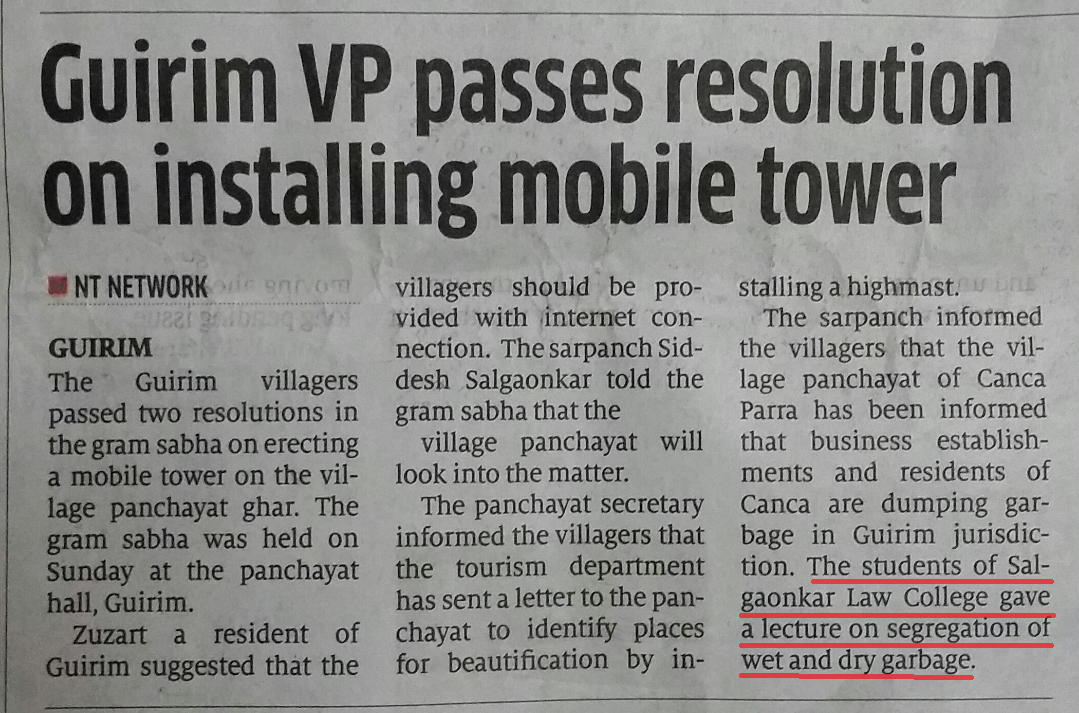
The first Major Legal Literacy program for the academic year 2015-16 was launched by the very enthusiastic team of Guirim Free Legal Aid Cell of V.M.Salgaocar College of Law. At the Gram Sabha of the Guirim Panchayat, the team of students organized an awareness program on Garbage Segregation and Related Environmental Laws on 30th August 2015. The program was organised by the students under the able guidance of Prof. Pearl Monteiro, Faculty in Charge of Guirim Free Legal Aid Cell.

The guest speaker for the day, Ms. Espie Kandolkar, Manager, Green Goa Works - an NGO for environmental causes spoke on the Importance of Garbage Segregation.

The waste we generate - seriousness of the problem
  • Garbage pollution is a huge global problem. We produce so many products and throw out so much every day that garbage and waste disposal is turning into a major ecological nightmare.
  • We waste a lot and throw away huge amounts of material that sites in a landfill and pollutes the soil and everything else.
  • It is high time we take this problem seriously. With global warming and decay of natural habitats, there is absolutely no time to waste.


Classification of waste

  • The waste can be classified into two forms:
Bio-degradable-Bio-degradable is known as materials that decompose through bacteria, fungi, and other living organisms.          
Non-Bio-degradable-Non-Bio-degradable is materials that do not decompose or cannot be degraded for so many years. This form of garbage is the main reason for the clogging of drainage. Common examples are plastic, bottles, old machine, cans, etc.
  • At our own homes there are biodegradable and non-biodegradable wastes available. All the wastes from the kitchen such as vegetables etc. are biodegradable and all the wastes such as plastic are non-biodegradable.

What actually makes it a problem - Mixing plastic with bio degradable waste
When we put all our biodegradable waste in a plastic bag along with glass, plastics, sanitary napkins and diapers in one bag and dispose it in a dustbin expecting the government and the Municipal and village authorities to clean the mess. The garbage when disposed like this, becomes impossible for any human to segregate. Because degradable waste will start to rot and if diapers and sanitary napkins and glass is present adds to the pathetic conditions. Also if one thinks that degradable can be put in a plastic bag and disposed then it is a big MISTAKE!!!!
#Segregate your waste

  • It is difficult for the decomposing organisms to breakdown the waste inside the bag and therefore advisable to have a small composting pit in your own garden and if you don’t have one, at least use paper bags to dispose the same.
  • Plastics, diapers, sanitary napkins and glass should definitely be put in separate bags and tied and thrown for the convenience of those people who help clear our mess.
  • All the items such as news paper, glass bottles, plastic bottles and other plastic items old electronics such as mobile phones, tape recorder etc. should be given out as scrape and sold to the scrape dealers since the scrape dealers segregate all these items and send it to the manufactures for recycling. This helps as a lot of waste is reduced in the bins which has to be then sorted out by the Municipal and village, garbage workers.


#The 3 'R's - Reuse, Reduce, Recycle

  • Always use the mantra of the 3 R’sReuse your commodity, Reduce your waste, Recycle your waste.
  • Lastly, segregate your waste responsibly to make a positive difference to the environment and start from your home. Also being the children of this village, help to keep this village free from garbage dumping and ask the Panchayat for dustbins where you can dispose your segregated waste.

Interaction by public
Description: C:\Users\DELL\Desktop\New folder (2)\20150830_110744.jpg
Around 100 persons from Guirim Village was present for the talk. Various questions with regard to how to compost the waste and which items should be put in which category while segregating and what are the various methods that the government uses to dispose the waste were asked. The speaker answered to all the queries one by one and cleared the doubts.


Students speak on environmental laws
  
Ms. Afrah Shaikh, the Student Cell Incharge and Mr.Shantanu Karnik Student Dy. Cell in charge) spoke on the various rules and legislations enacted with regards to the Environment including The Environment (Protection) Rules, 1986 , The Municipal Solid Wastes (Management and Handling) Rules, 2000 and Electronic Waste (Management and Handling) Rules,2011. 


Research: The Preliminary Research Proposal, which is a pre-requisite for any Legal Literacy Program by the Legal Aid Cells was prepared by Siya Parob and Tanvi Naik (garbage segregation) and Afrah Shaikh (Environment related Acts and Rules).
Feedback: The audience expressed their appreciation for the program and observed that they were very impressed with the talk, since garbage dumping and garbage collection is a major problem in the Village  
Support: The Guirim Panchayat was extremely supportive in granting the venue and time out of their Gram Sabha Meeting for the program. At the expense of the Panchayat, refreshments were provided.

GUIRIM FREE LEGAL AID CELL

MEMBERS: Sridhesh Naik, Afrah Shaikh, Karishma D’mello, Shannon de Almeida, Sailee Kenny, Shantanu Karnik, Dorika Dias, Sr.Jolly George, Siya Parob, Tanvi Naik and Abhishek Petkar
C:\Users\DELL\Desktop\New folder (2)\New Bitmap Image (4).bmp